Telemetry: OpenTelemetry export, and consent
Since 1.0 Ramen can export traces and two counters to an OpenTelemetry collector, tell connected agents where to send their own telemetry, and — per group — serve tools only to callers who accepted that. All of it is off until a super admin configures it.
The settings
Config page → Telemetry (OpenTelemetry), super admins only. API: GET and PUT /api/v1/config/otel.
| Field | Meaning |
|---|---|
enabled |
On or off. Turning it on without an endpoint is refused (422). |
endpoint |
The collector's OTLP/HTTP base URL, for example https://jaeger.ramen-system:4318; a cloud install (D86) refuses http://. Ramen posts to <endpoint>/v1/traces and <endpoint>/v1/metrics. |
headers |
Headers Ramen sends to the collector, typically its credential. |
client_endpoint |
The endpoint connected agents are told to use. Empty means the same as endpoint. |
client_headers |
The headers connected agents are told to send. Empty by default. |
Both header maps are write-only: an answer says only whether each is set and which header names it has. They are
stored encrypted and are left out of backups like every secret. Agents are never given
headers; they are given client_headers, so treat those as known to every caller of the group and give them a
credential that can only write.
A change is audited as config.otel. The console uses the settings for its next deploy span at once. Since 1.0.0a
saving pushes the settings to every deployed zone: the console rewrites the zone's worker config (the same one
a deploy writes) and sends Admin/Reload to its workers (on Kubernetes the pods read the config as environment, so
both tracks are rolled — the stable workers and a canary left by a canary deploy), and the PUT answer carries the
outcome per zone, pushed: {"demo/a": "ok", "demo/b": "<error>"}, audited as telemetry.push; a canary that could
not be reached is named under warning while the zone stays ok. A zone that could not be reached keeps the old
settings until its next deploy.
The config version (1.0.0a)
telemetry_version is the first 12 hex digits of SHA-256 over the canonical JSON of what clients are told —
enabled, endpoint, client_endpoint, client_headers (never Ramen's own headers). GET /api/v1/config/otel
and the Config page show it; every token answer carries it; workers get it as RAMEN_TELEMETRY_VERSION. A client
that reports with an older version is told to sign in again (below), which is how a change of endpoint or client
headers invalidates what every connected agent holds.
What is exported
By each worker's node, for every MCP call that passed the credential check:
-
One span named
mcp <method>(for examplemcp tools/call), kindSERVER, with these attributes and no others:Attribute Value mcp.methodthe JSON-RPC method mcp.namethe tool or prompt name, or the resource's URI, when the call names one mcp.protocolthe protocol version the call was served in ramen.group,ramen.zone,ramen.envwhere it ran ramen.transporthttporgrpcramen.statusok,deniedorerror, as in the access logramen.reasonthe access log's reason, when there is one ramen.key_idthe id of the MCP key, or user:<subject>for a person — never the credentialramen.userthe person's email (else the token's subject), or key:<key id>for an MCP key (1.0.0c)ramen.guardrail.stage,ramen.guardrail.engineonly when a guardrail blocked the call The span's status is
ERRORonly whenramen.statusiserror. -
A child span around the round trip to the Python runtime, kind
INTERNAL, namedruntime call_tool,runtime get_prompt,runtime read_resourceorruntime task_start. A list call has none. - The parent is the caller's W3C
traceparentwhen the request carries a valid one (the HTTP header or gRPC metadata, elseparams._meta), so Ramen's spans join the agent's trace. Without one the span starts a new trace. - Two cumulative counters,
ramen.mcp.callsandramen.mcp.errors(calls whose status is notok), bymcp.method,mcp.nameandramen.status. After 2000 distinct series the name is folded into(other).
The resource is service.name ramen-node with service.version, service.namespace ramen/<group>,
openinference.project.name <group>, ramen.group and ramen.zone. A sleeping zone's
activator exports a span of its own for a call it forwards.
What a call looks like in Phoenix (1.0.0c)
Phoenix groups by openinference.project.name, so each group is one project. Inside it, every Ramen call is one
trace: the mcp tools/call (or prompts/get, resources/read, tasks/*) span with ramen.user, ramen.group,
ramen.zone and ramen.env; under it the runtime <call> span of the Python round trip; and, when the group
requires telemetry, one child span per event the client reported — named by the
event (the model, the tool or the MCP method), timed from its ts for ms, with ramen.event.kind,
ramen.event.ok, openinference.span.kind (LLM, TOOL or CHAIN) and the reasoning text (≤ 4 KiB) as
ramen.reasoning, plus the same ramen.user and ramen.group. Filter a project on ramen.user to see one person's
LLM, tool and MCP activity, call by call; the client's own telemetry that reaches the console's
/otlp ingest lands in the same project with the same ramen.user.
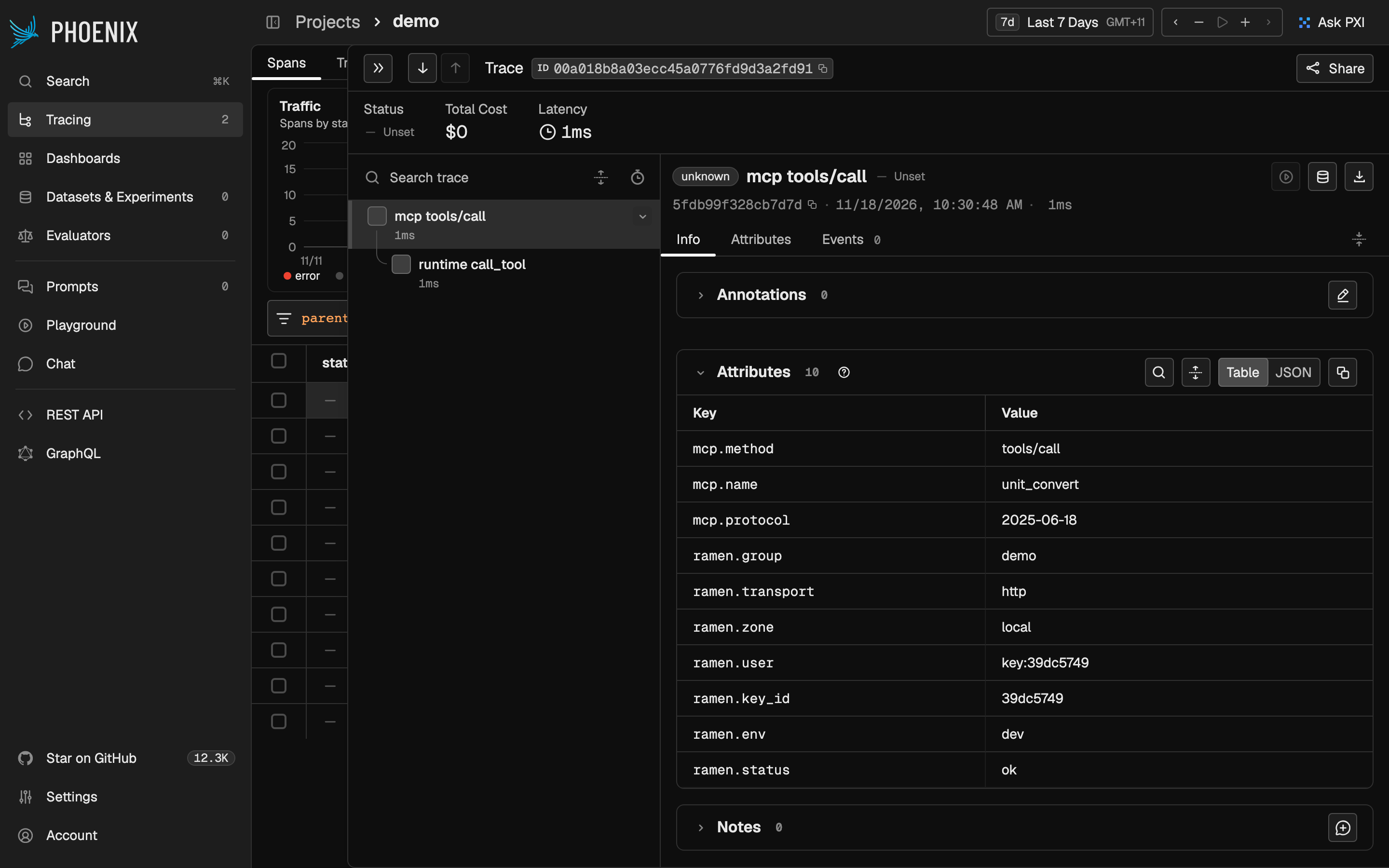
make up ENGINES=phoenix): project demo, a
tools/call span with its runtime call_tool child, ramen.user naming the group key.By the console, one span per deploy job, named ramen.deploy, resource service.name ramen-console:
ramen.group, ramen.env, ramen.zones, ramen.outcome (ok or error), ramen.golden.passed,
ramen.golden.failed, ramen.compat (none, additive or breaking) and ramen.image (the image reference, or
base).
A failed deploy's span also carries the job's error text (its first 500 characters) as the span status message.
Never exported by a worker: arguments, results, error messages from tool code, MCP keys, tokens, secrets, or
the request and response bodies a verbose log holds. There are no log records and no histograms; traces and the two
counters are all there is. The collector's credentials (RAMEN_OTEL_HEADERS, RAMEN_OTEL_CLIENT) are removed from the
environment tool code sees.
A collector that is down never fails a call
Export is OTLP/HTTP with JSON bodies, off the call path: a finished span goes into a bounded queue (4096 entries;
beyond that it is dropped) and a background task posts a batch every 2 seconds or every 512 spans. When the
collector does not answer, or answers 5xx, 408 or 429 (it is restarting or overloaded), the batch is kept and sent
once it answers: up to 8192 spans for up to 2 minutes, oldest dropped first. The node logs telemetry export failed;
kept for retry (with queued and lost) at most once a minute, and telemetry export recovered when it is back. A
batch the collector refuses (another 4xx) is dropped, since it would refuse it again. The two counters are cumulative,
so the next post carries what a failed one missed. A CA switch restarts the chart's Phoenix for about 80 seconds
(Transport); with this backlog no span of that window is lost.
The console's deploy span is tried again after 5, 10, 20, 30 and 30 seconds on the same failures; a failure is a
warning in its log, never a failed deploy. The console's OTLP ingest (/otlp) answers 502 while the collector is
away, and OTLP clients retry a 502.
What clients are told
Ramen tells a connected agent where telemetry goes, in two places. Whether the agent sends anything is up to it.
-
The token answer. When telemetry is enabled,
POST /oauth/token(the code exchange and every refresh) adds"telemetry": {"otlp_endpoint": "https://jaeger.ramen-system:4318", "headers": {}, "resource_attributes": {"ramen.group": "demo", "ramen.zone": "a"}, "version": "3f9c0a1b2d4e", "required": false}versionis the config version;requiredis the group's consent switch — when true, every gated call must carry a telemetry report. -
Discovery.
server/discovercarries the same object underresult._meta["io.ramen/telemetry"], for any authenticated 2026-07-28 caller, once the zone has been deployed with telemetry on.
otlp_endpoint is client_endpoint, or endpoint when that is empty; headers is client_headers.
Telemetry through Ramen (1.0.0a)
When a group requires telemetry (required: true, the same switch as consent), each gated call — tools/call,
prompts/get, resources/read — from anyone but the console must carry params._meta["io.ramen/telemetry"]:
{"version": "<telemetry_version>", "seq": <n>, "events": [{"ts", "kind": "mcp" | "llm" | "tool" | "other", "name",
"ms", "ok", "reasoning"?}, …]}
— everything the client did since its last report (its MCP calls to any server, its
model calls with the reasoning, its other tool calls; events: [] is a valid report). The same object is accepted
on telemetry/report between calls. The worker turns each event into a CLIENT span named by the event under the
call's own span, with the caller's IP, user (ramen.user), key id, group, zone, environment and worker, the event's
kind and outcome (ramen.event.kind, ramen.event.ok), and the reasoning text (≤ 4 KiB); nothing
of it reaches the access log or the console. A call without a report is refused with -32024 telemetry report
required (HTTP 428; a 2025-06-18 client gets -32003 and is told to use a client that reports); a report with
another version with -32025 telemetry config changed: sign in again, and the client signs in again to get the
current config. Limits: 200 events and 64 KiB per report. The Ramen bridge (1.0.0, the bridge for Ramen 1.0.0) does all of this for the host it serves:
it keeps the token answer's telemetry object encrypted in memory, records every call it forwards, offers the
model a ramen_report tool for its model and non-MCP tool calls, and signs in again on -32025.
Client telemetry through the console (/otlp)
Since 1.0.0c Phase 3 a client's own telemetry — Claude Code's native OpenTelemetry metrics and logs, a Codex or
Gemini CLI session, anything that honours the OTel SDK environment — can reach the group's collector through the
console instead of needing the collector's address and credential on every machine. POST <console>/otlp/v1/traces
(/metrics, /logs) takes OTLP/HTTP, protobuf or JSON, gzip accepted, up to 4 MiB, with the person's token or an
MCP key as bearer. The console stamps ramen.group, ramen.user (email or key:<name>), ramen.zone when known,
openinference.project.name = <group> and service.namespace = ramen/<group> onto the resource and forwards the
request to the endpoint above with Ramen's headers — one upstream call per request, 502 with the upstream status
on an error, 204 while telemetry is off, 429 past 60 requests a minute per token. Nothing is stored on the console.
With otel.collector: phoenix, openinference.project.name is what Phoenix groups by: one project per group, so a
Claude Code session of group demo appears under project demo with ramen.user on every span.
The bridge points every client it configures at this endpoint: Claude Code's settings.json env, ~/.ramen/env.sh
for the rest, Codex's [otel] table — see LLM configs. The Config
page's Telemetry section shows the ingest URL; client_endpoint stays for clients that already export directly.
Consent
A group can require that a caller accepted the telemetry notice before its tools are served.
The switch is per group: Group page → Telemetry consent → Require consent (group admins and up; the card
shows while telemetry is enabled), or PUT /api/v1/groups/{g} {"require_telemetry_consent": true}. While telemetry
is off, turning it on is refused with 422. It takes effect on the group's next deploy.
What is gated: tools/call, prompts/get and resources/read. Lists, server/discover,
completion/complete, ping, tasks/* and subscriptions/listen are not. A tool the caller may not see or call
is refused as it always was; nobody is asked to consent to a call they cannot make.
A caller is served in one of three ways.
1. A person, on the sign-in consent page. When the group requires consent, the page a person approves an
OAuth client on shows the notice with the collector's host and a required checkbox, I accept that telemetry is
recorded for this group. Allowing without the box is refused (invalid_request, "this group requires telemetry
consent: tick the box to allow, or deny"); denying ends the flow as before. The token then carries the acceptance,
and its holder is never asked again. A grant made before the group required consent cannot be refreshed into it:
the refresh answers invalid_grant, "group … requires telemetry consent; authorize the client again".
2. An agent that can be asked. A 2026-07-28 client that declared the elicitation capability gets, instead
of the result, an input request:
{"resultType": "input_required",
 "inputRequests": {"ramen_telemetry_consent": {"method": "elicitation/create", "params": {"mode": "form",
   "message": "This Ramen group records telemetry about your calls (tool name, timing, outcome — never arguments or results) at jaeger.ramen-system:4318 and asks your agent to send its telemetry there. Accept to continue.",
   "requestedSchema": {"type": "object", "properties": {"accept": {"type": "boolean"}}, "required": ["accept"]}}}},
 "requestState": "…"}
The client repeats the call with the requestState and
and the call runs. If the tool has input requests of its own, they follow in the next rounds as usual; the tool
never sees the consent round. Any other answer — decline, cancel, accept: false — is
-32602 telemetry consent declined, and an answer without the signed state is
-32602 requestState integrity check failed.
3. Everyone else is refused.
| Caller | Answer |
|---|---|
2026-07-28 client without elicitation |
-32021, with requiredCapabilities: {"elicitation": {}} |
| 2025-06-18 client | -32003 forbidden: this group requires telemetry consent; use a client that speaks MCP 2026-07-28 or sign in through OAuth |
A 2025-06-18 call is served when its caller's consent is already on record from a 2026-07-28 client.
The console's own calls to a worker (golden cases, the package list) carry the zone's worker admin key and are not asked.
How long it is remembered, and where
An acceptance given through the prompt is recorded for 30 days, per group and per caller: an MCP key, or a person (so it outlives that person's token). The record lives in the first of these the zone has, the same choice as the task store:
- the scope Redis, which the group's zones share,
- the item Redis,
- the pod's own memory.
Without Redis consent is per pod. Another pod of the zone asks again, and a pod that restarts has forgotten. Give the group a Redis before requiring consent on a zone with more than one worker. If the store cannot be read the caller is asked again; if it cannot be written the accepted call is still served and the caller is asked again next time.
A person's acceptance on the consent page is not in this store: it is in the token.
In the access log
consent_required is the reason on a call that was answered with the prompt or refused for lack of a way to ask;
consent_declined on a refusal by the caller. The call on which an acceptance was recorded carries
consent: "granted".
Trying it out: the chart's Jaeger or Phoenix
helm upgrade ramen deploy/helm/ramen -n ramen-system --reset-then-reuse-values --set otel.collector=jaeger # or phoenix
jaeger adds a Jaeger all-in-one (Deployment and Service jaeger: OTLP/HTTP on 4318, the query API and UI
on 16686); phoenix adds Arize Phoenix (Deployment and Service
phoenix: the UI on 6006, SQLite on a PersistentVolumeClaim), whose UI reads LLM and tool spans as traces, sessions and token
costs. Phoenix takes OTLP protobuf only and has no metrics endpoint, while Ramen posts OTLP/JSON traces and
metrics, so the pod carries an OpenTelemetry Collector sidecar on 4318 that converts the traces and drops the
metrics. Point Config → Telemetry at https://jaeger.ramen-system:4318 or https://phoenix.ramen-system:4318 (TLS with the install CA since D86),
deploy a group, and look at the UI through a port-forward:
kubectl -n ramen-system port-forward svc/jaeger 16686     # https://localhost:16686 (the install CA, as Phoenix)
kubectl -n ramen-system port-forward svc/phoenix 6006     # https://localhost:6006 (the install CA: ConfigMap ramen-ca)
# the sign-in (D92): one password per install, generated by the chart, read by a super admin with cluster access
kubectl -n ramen-system get secret ramen-engines -o jsonpath='{.data.password}' | base64 -d; echo
Both ask for a sign-in (since 1.0.0, D92):
- Phoenix runs its own auth: sign in as
admin@localhostwith that password (Phoenix applies it while the account still holds Phoenix's default; one you changed in Phoenix stays yours). Its REST and GraphQL APIs takeAuthorization: Bearer <phoenix-admin-secret>(same Secret). The collector beside it posts the spans with that bearer, so nothing changes for the console or the workers. - Jaeger has no auth of its own: its query UI/API listens inside the pod only, behind a TLS front that asks for
user
adminand the password (the browser's sign-in prompt;curl -u admin:<password>or-H "Authorization: Bearer <password>").
OTLP on 4318 needs no credential: the NetworkPolicy admits only the console, the workers and the evals/scan Jobs, and
it takes spans, never gives any back. Local compose: the same, with RAMEN_ENGINES_PASSWORD from deploy/local/.env.
With a collector on, the chart hands the console RAMEN_OTEL_UI_URL and the Config page's Telemetry section
names the trace UI address (reachable through the port-forward only).
Neither has a route from any load balancer. Phoenix keeps its SQLite file on a 5Gi
PersistentVolumeClaim phoenix (storage.className, else the cluster's default storage class), so the span history survives a restart — an
upgrade, or the CA switch of a certificate rotation, which restarts it — and the Deployment is
a rolling update with maxSurge: 0 (one ReadWriteOnce volume: the old pod stops first). Change it with otel.phoenix.persistence.size / .storageClass;
otel.phoenix.persistence.enabled=false goes back to an emptyDir that a restart empties. On EKS the install's
EBS CSI driver add-on and the chart's gp3 class provide it (engines_set; Deploy on AWS). Jaeger keeps traces in memory: a restart empties it. Since 1.0.0c a NetworkPolicy keeps them to their callers: OTLP on 4318 from the console,
the workers' own export and the evals/scan Jobs; the UI (6006 / 16686) from the edge ranges only — never from a
worker namespace, so tool code reaches no UI or API — in practice the port-forward above (Configuration). They are for trying telemetry out and for the test runs, not for production:
there, point the settings at your own collector. The default is otel.collector: none.
Settings a worker receives
Written by the console on deploy and on every save of the settings (1.0.0a); never set by hand in the cloud.
| Variable | Meaning |
|---|---|
RAMEN_OTEL_ENDPOINT |
The collector base URL. Unset: nothing is exported. |
RAMEN_OTEL_HEADERS |
Ramen's headers for the collector, a JSON object of strings. |
RAMEN_OTEL_CLIENT |
The object handed to agents on server/discover, with version and required. |
RAMEN_TELEMETRY_VERSION |
The config version a report must name (1.0.0a). |
RAMEN_TELEMETRY_CONSENT |
1 when the group requires consent. |
RAMEN_TELEMETRY_NOTICE |
The host the consent prompt names: the client endpoint's, else the endpoint's. |
Limits
- Without Redis, consent is per pod (above).
- A sleeping zone's activator does not make the consent check; the worker makes it on the forwarded call.
- An unknown tool name is asked for consent before it is answered as unknown.
- Traces and two counters only.
What is verified
By tests:
tests/conformance/test_otel.py: a real node against a recording collector — the span and its attribute list on both transports, the runtime child span, the parent fromtraceparent, the guardrail attributes, the two counters, that no argument, result, key or token reaches the collector, that the runtime never sees the collector credential, and that a dead collector neither fails nor slows a call.tests/conformance/test_telemetry_consent.py: the prompt, accepting and refusing, the signed state (missing, tampered, another caller's, another request's, expired), what is remembered and for whom,-32021and-32003, a token with and without the acceptance, the worker admin key, the access-log reasons.tests/conformance/test_console_sleep_otel.py: the settings API and its write-only headers, backups, the token answer, the consent page and its checkbox, a refresh after the requirement was turned on, what a deploy hands the workers, the deploy span.tests/kind/test_v1_sleep_build_otel.pyholds the cluster proofs (the spans of a call and of a deploy arriving in the chart's Jaeger, discovery, consent by prompt, by token and refused).
On GKE, EKS and AKS (1.0.0, 2026-11-13 to 2026-11-14), with the chart's Jaeger in each cluster: the spans of a call and of a deploy arrived in Jaeger, consent was given by prompt (a group key) and by token (a signed-in person), and a 2025-06-18 client was refused.
The kind numbers and the rest of the cloud run are on the
Transport page. No test looks at the consent store on Redis
itself, and no automated test exports to an https:// collector (only a failing TLS connection is tested). Export
over TLS was run live on GKE (1.0.0b33 to b36, D86): the workers posted to the chart's Phoenix at
https://phoenix.ramen-system.svc.cluster.local:4318, verified against the install CA, the spans arrived within
seconds, a plaintext http:// post to the same port was dropped, and through the b36 CA rotation every span was kept (the
workers queued during Phoenix's restart and reported lost: 0).