Configuration
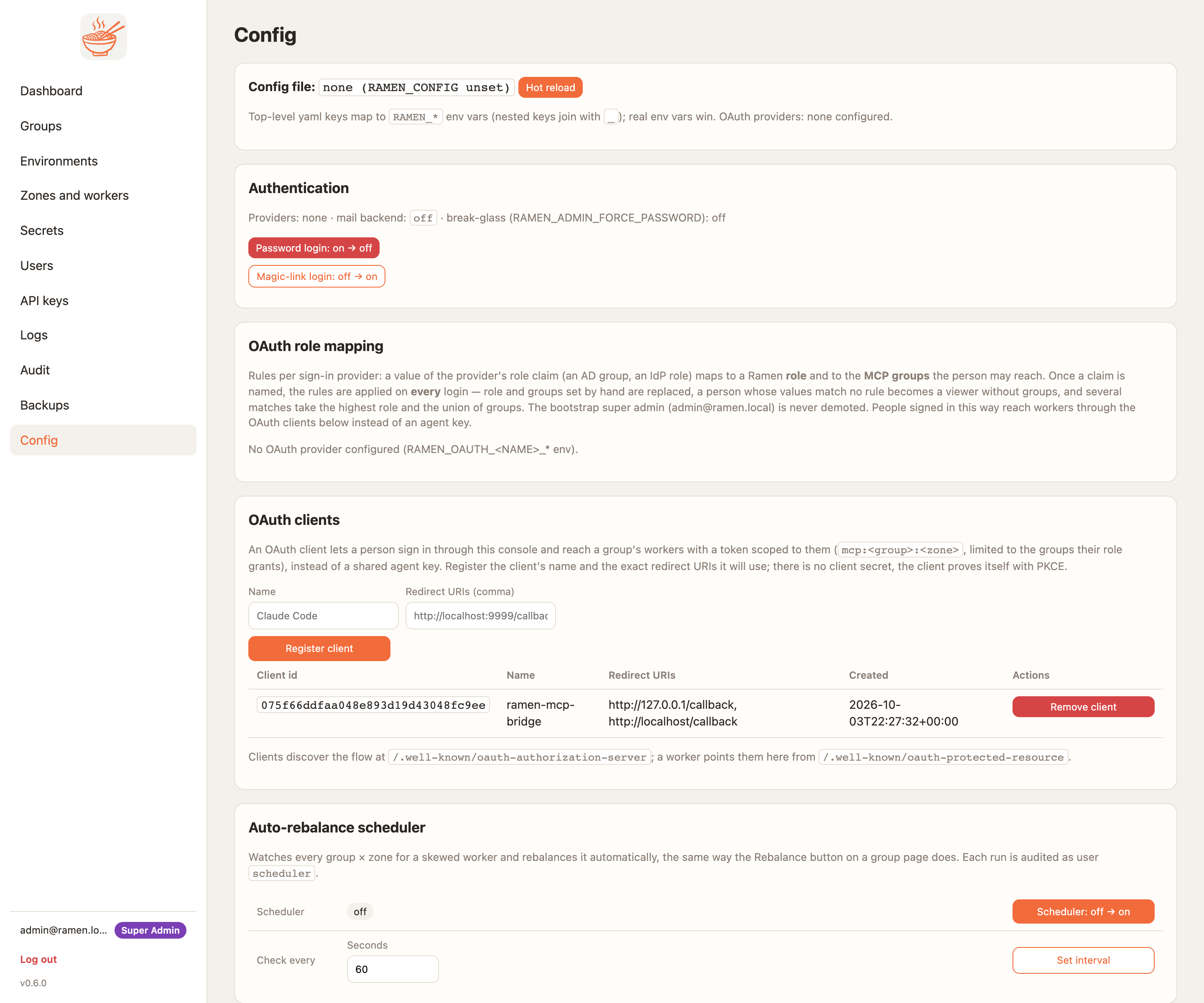
Everything the console and the workers read comes from RAMEN_* environment variables. A yaml file can hold
them too, and the environment wins. The Config page shows the effective values with secrets masked, the file in
use, a Hot reload button, and the settings a super admin edits in the browser.
The config file
RAMEN_CONFIG=/path/ramen.yaml. Top-level keys map to RAMEN_<KEY>; nested keys join with _.
public_url: https://console.example.com      # RAMEN_PUBLIC_URL: links in mail and the OAuth issuer
store: firestore                             # RAMEN_STORE: memory | firestore | dynamodb | postgres
secrets_backend: gcp                         # RAMEN_SECRETS_BACKEND: store | gcp | aws
cookie_secure: "1"                           # https only and HSTS; the charts set it
auth:
  password_login: true                       # RAMEN_AUTH_PASSWORD_LOGIN
  magic_link: false                          # RAMEN_AUTH_MAGIC_LINK
  oauth:
    entra:                                   # RAMEN_AUTH_OAUTH_ENTRA_ROLE_CLAIM and _ROLE_MAP
      role_claim: groups
      role_map: "0b7f...=group_admin:demo,analytics;9c1e...=viewer:analytics"
oauth:
  entra:                                     # RAMEN_OAUTH_ENTRA_{ISSUER,CLIENT_ID,CLIENT_SECRET,SCOPES}
    issuer: https://login.microsoftonline.com/<tenant>/v2.0
    client_id: ...
    client_secret: ...
smtp:
  host: smtp.example.com                     # RAMEN_SMTP_{HOST,PORT,USER,PASSWORD,FROM,TLS}
  from: ramen@example.com
What the Config page edits is stored in the console store and layered over the file: authentication toggles, OAuth role rules, OAuth clients, SMTP and the warning-email list, the GitHub App, the auto-rebalance scheduler, the service-account rules and the permission catalogue.
The state store
RAMEN_STORE |
Backend | When |
|---|---|---|
firestore |
Firestore Native | the GCP default |
dynamodb |
DynamoDB, one table | the AWS default |
postgres |
Postgres, one table, created on first use | self-hosted, or any deployment without a cloud document store |
memory |
in process | tests and local development only |
Postgres takes RAMEN_POSTGRES_DSN. On Helm: --set console.env.RAMEN_STORE=postgres --set
console.secrets.RAMEN_POSTGRES_DSN=postgresql://.... RAMEN_FERNET_KEY wraps every backend the same way.
The variables that matter
| Variable | Read by | Meaning |
|---|---|---|
RAMEN_PUBLIC_URL |
console, handed to workers | The address people and clients use, and the OAuth issuer the workers trust. Without it OAuth is off for the workers. |
RAMEN_STORE, RAMEN_POSTGRES_DSN |
console | The state store. |
RAMEN_SECRETS_BACKEND |
console | Where secret values live: store, gcp or aws. |
RAMEN_FERNET_KEY |
console | Encrypts password hashes, secret values, key hashes and tokens in the store. Generate once, keep forever. |
RAMEN_ADMIN_EMAIL, RAMEN_ADMIN_PASSWORD |
console | The bootstrap super admin, re-applied on every start. RAMEN_ADMIN_FORCE_PASSWORD=1 is the break-glass. |
RAMEN_COOKIE_SECURE |
console | 1 on a public console: secure cookies and HSTS. Plain http gets a 301 for GET and a 403 otherwise when a proxy terminated it; the cloud edges have no port 80 at all. |
RAMEN_LOGIN_RATE_LIMIT |
console | Failed sign-ins per address per minute, default 20. |
RAMEN_OAUTH_<NAME>_* |
console | An OIDC provider: issuer, client id and secret, scopes. |
RAMEN_SMTP_* |
console | Mail for magic links and warning digests. |
RAMEN_MCP_KEYS, RAMEN_ALLOWED_CIDRS, RAMEN_ADMIN_KEY, RAMEN_BLOCKED |
worker | Written by the console on deploy. Never set by hand in the cloud. |
RAMEN_VERBOSE |
worker | 1 logs full request and response bodies. Toggle per environment on the group page. |
RAMEN_SIDECAR_IDLE_SECS |
worker | Seconds of idleness before the Python runtime stops, default 300. |
RAMEN_CALL_TIMEOUT_SECS, RAMEN_MAX_INFLIGHT |
worker | Per-call deadline and the in-flight bound. |
RAMEN_TRUST_PROXY_HOPS |
worker | Proxies between the client and the node: 2 on GCP, 1 on AWS, set by the charts. A wrong value denies, never admits. |
RAMEN_ALLOWED_ORIGINS |
worker | Browser origins allowed on /mcp. Empty by default, so every browser origin is refused. |
RAMEN_SESSION_SECRET |
console, handed to workers | Signs the MCP session ids and the OAuth tokens a worker verifies. The console generates one per group and writes it into each zone on deploy. |
RAMEN_SESSION_TTL_SECS |
worker | How long an MCP session id stays valid, default 1800. |
RAMEN_ADMIN_CIDRS |
worker | Source ranges allowed on the Admin gRPC service. Any by default; the admin key is the gate that always applies. |
RAMEN_REDIS_ITEM_URL, RAMEN_REDIS_SCOPE_URL |
worker | The two throttle Redis instances, written by the console from the group page. Dialed when the node starts. |
RAMEN_TLS_CERT, RAMEN_TLS_KEY |
worker | PEM paths that make the node terminate TLS itself. The console then also needs RAMEN_WORKER_TLS=1, or every deploy fails. |
RAMEN_REFLECTION |
worker | gRPC server reflection. On by default, set to 0 on deployed workers by the charts. |
RAMEN_BACKUP_ROOT |
console | Where a local backup is written. |
RAMEN_MIN_PASSWORD_LEN |
console | Raises the twelve-character floor; it can never lower it. |
RAMEN_LOG_FILE, RAMEN_NODE_PORT |
worker | The access log's path and the port the node listens on. |
RAMEN_CONFIG |
both | The yaml file above. |
The complete list is in contract §3 and §4. Precedence runs the config file, then the environment, then the deploy file the console writes next to the group's code.
Restricting actions
- Service-account rules on the Config page gate what any group may request for its zone identities. Deny wins; with allow rules present a permission must match one. Group admins add stricter restrictions per group, and a clash is refused.
- Allowed worker sizes per zone are set by super admins in the group page's Zone actions card.
- Blocked packages per environment and zone are set on the group page.
- Password login can be switched off once another way in exists.
- API keys, backups, audit and config are super-admin pages. Group deletion is super-admin only.
Upgrading
Push the new images, then roll the console: make push, then kubectl -n ramen-system rollout restart
deploy/console. The console reads its version from the installed package, so the sidebar tells you what is
actually running.
Workers are not rolled by that. Each group's zones pick up the new worker image on their next deploy, so a release reaches a group when someone deploys it, and a group pinned to a recorded image stays there until the pin is changed. Nothing breaks in the meantime: the transport has been stable since 0.3.1.
Open sessions and OAuth tokens survive an upgrade, because both are signed with the per-group session secret rather than anything version-specific. A restore into a fresh console is the case that invalidates them, and the fix there is to deploy each environment again.
SMTP on the Config page or RAMEN_SMTP_*. It carries magic-link sign-ins and a digest of warnings and errors to
the notify list, batched every thirty seconds.
The local stack
deploy/local/.env holds the compose stack's values: the admin account, the Fernet key, the local MCP and admin
keys and the image version. make env copies the example. The compose console serves TLS on 8443 with a
self-signed certificate; the worker on 8080 is plaintext and open, and is for a machine you control only.