Secrets: how they are managed and mapped at runtime
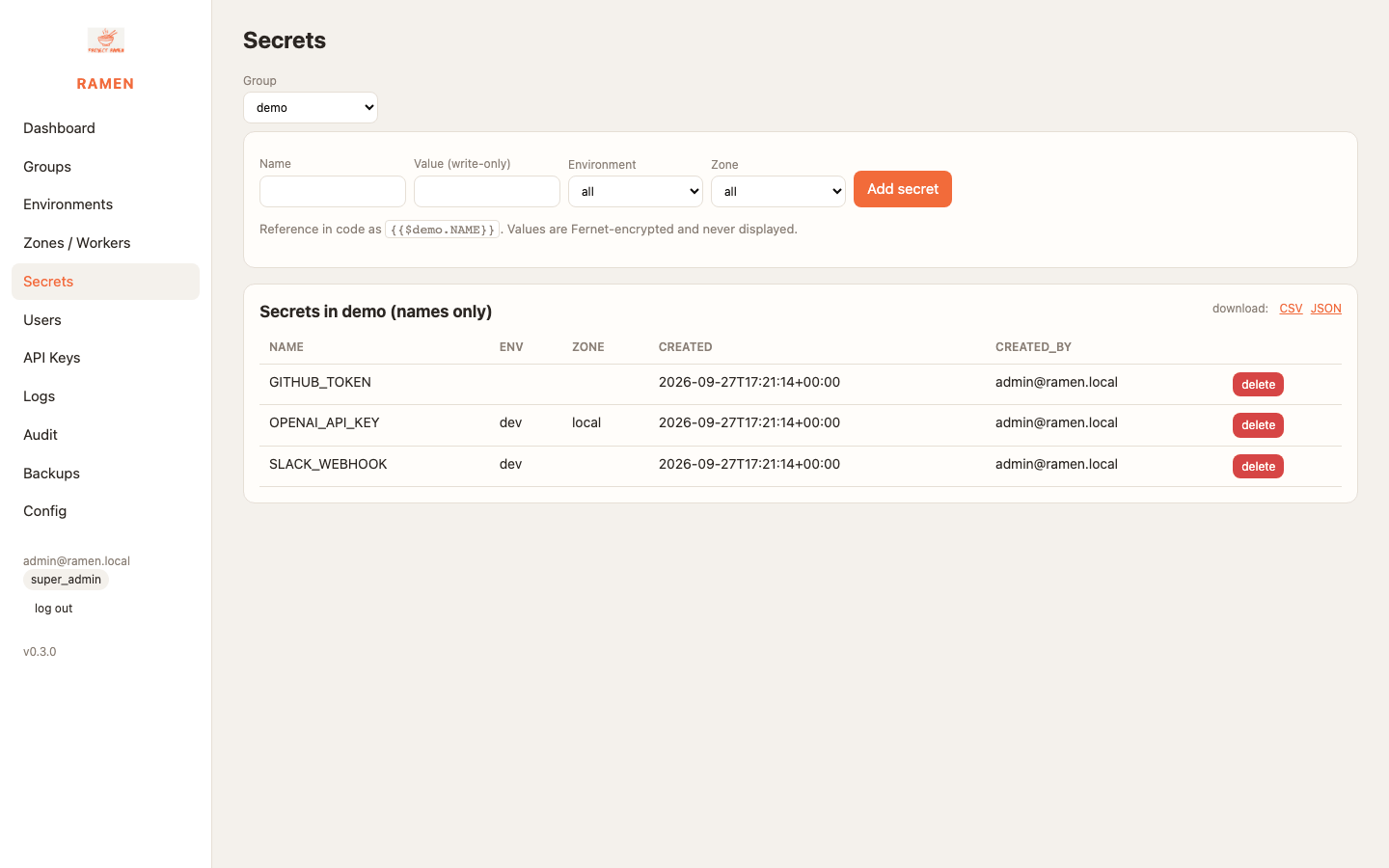
A secret is a named value under a group, optionally narrowed to an environment and a zone. The console never shows a value back: not on the Secrets page, not in the API, not in backups, not in logs. Super admins and group admins add the values, read the names and delete them. A viewer cannot open the Secrets page at all.
Scope
| Scope | Applies to |
|---|---|
| group only | every environment and zone of the group |
| group + environment | that environment in every zone |
| group + environment + zone | that zone of that environment |
The most specific scope wins on a name clash. On deploy the console resolves the secrets that match the target environment and zone.
Add one
Secrets → choose the group → name, value, optional environment and zone → Add. The page is open to super admins and group admins only.
Then deploy the environment. Secrets reach workers only through a deploy.
How a secret reaches your code
The deploy writes each resolved secret into the zone's Secret as RAMEN_SECRET_<GROUP>__<NAME>, upper-cased.
The runtime maps it two ways:
- In call arguments. Any string a client passes that contains
{{$demo.OPENAI_API_KEY}}is substituted before the function runs. Nested strings too. Unknown references stay literal. - Through
mcp/env.yaml. The worker renders the file's{{$group.NAME}}references and exports every key to the runtime process at load. Code readsos.environ["DB_URL"].
Values are redacted from exception messages and never logged. A reference with no secret behind it is skipped with a warning so the rest of the file still applies.
Where values live
RAMEN_SECRETS_BACKEND |
Where | What the worker identity needs |
|---|---|---|
store |
the console store, Fernet-encrypted with RAMEN_FERNET_KEY (local, kind) |
nothing; the console injects the value on deploy |
gcp |
Secret Manager ramen-<group>-<env or all>-<zone or all>-<NAME> |
secretAccessor on ramen-<group>-*, granted at zone creation |
aws |
Secrets Manager ramen/<group>/<env or all>/<zone or all>/<NAME> |
GetSecretValue on ramen/<group>/*, granted at zone creation |
The charts set gcp and aws. MCP keys are stored through the same backend.
Special names
GITHUB_TOKEN is used by the console to clone a private group repo. It can be group- or environment-scoped. The
group's fallback GitHub token field on the group page is the alternative.
Rotate
Delete and add under the same name, then deploy. Workers pick the new value up during the canary reload. The rotate-keys skill covers keys and the Fernet key.