Architecture (current: v0.8.0; the product is 0.7.5)
Hierarchy: Group → Environment → Zone → Worker (decision D5). Transport: Streamable HTTP at the edge, gRPC inside (D31; gRPC since D19).
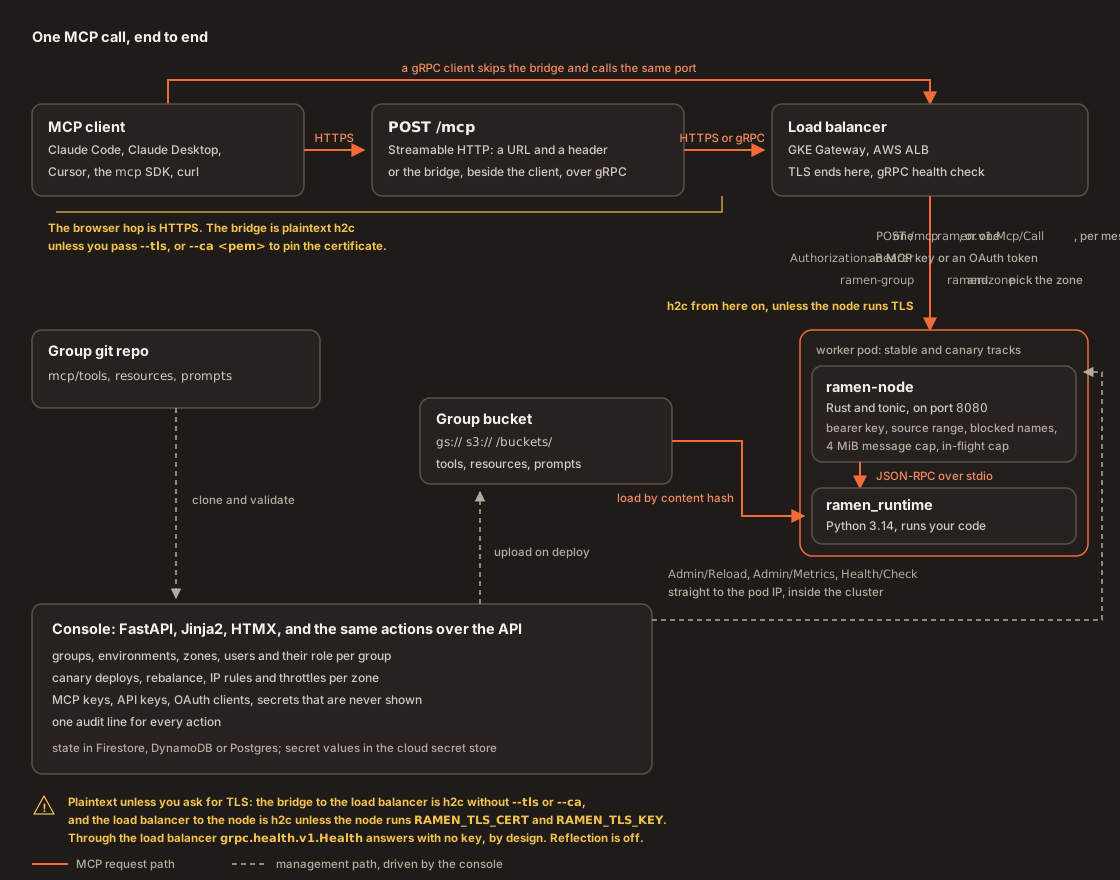
Store: Firestore, DynamoDB, Azure Table Storage or Postgres. Cloud adapter: local, gcp, aws or azure
(namespaces, Deployments, routes, NEG or target groups, Cloud Armor, WAF or Envoy SecurityPolicy, per-zone cloud
identity). Secrets backend: the store, Secret Manager, Secrets Manager or Key Vault. Since 0.7.5 the console also
scales the workers of every group × zone between 1 and an admin's max (no HPA).
The console reaches workers over gRPC on the pod IP (Admin/Reload, Admin/Metrics, Health/Check), never
through the load balancer.
Components
| Dir | What | Tech | Contract |
|---|---|---|---|
console/ |
Manager UI + /api/v1; roles per group (D41) and custom roles (D48), the OAuth 2.1 authorization server (D34), identity providers on the Config page with group lookup (D47, D50), IdP role mapping (D38), scoped service-account policy (D40), autoscaling (autoscale.py, D55); gRPC client to workers (ramen_console.grpcclient) |
FastAPI, Jinja2, HTMX (no JS build, no unsafe-eval), argon2, itsdangerous, Fernet, grpcio |
§4, §4a, §9, §11, §16.3 |
node-rs/ |
MCP server node: ramen.v1.Mcp/Call, ramen.v1.Admin, grpc.health.v1.Health on one h2c/TLS port; bearer auth, CIDR allow-lists, blocked names, in-flight limit, access log, sidecar supervisor |
Rust 1.98, tonic, tokio | §11 |
runtime-py/ |
Loads mcp/ packages from the bucket (gs://, s3://, az://), validates protos, pip-installs requirements, renders mcp/env.yaml from secrets (0.6.0), runs mcp/guardrails.yaml pre/post hooks (NeMo or policy.py, D46), executes calls, resolves and redacts secrets |
Python 3.12 (pinned, D45), jsonschema, optional NeMo Guardrails | §1, §2, §11 |
ramen-mcp-bridge (own repo, PyPI) |
Stdio MCP server forwarding to Mcp/Call over gRPC with a group key or, since 0.2.0, the person's own OAuth token (PKCE + loopback callback against the console); 0.3.0 keeps tokens in memory or the OS keychain and relays a needed sign-in as error -32001 (D52) |
Python, grpcio | §11, §16.3 |
proto/ramen/v1/ |
mcp.proto, admin.proto — single source for Rust (tonic-build) and Python (grpcio-tools) stubs |
protobuf 3 | §11 |
deploy/local |
docker compose: Firestore emulator + console + one worker (gRPC h2c on 8080) | §5, §11 | |
deploy/terraform/gcp, deploy/helm/* |
GKE Autopilot, Firestore, GCS, Artifact Registry, static IP, GSA + Workload Identity (custom role, resource-level IAM), GKE Gateway with header routes + gRPC health | Terraform, Helm 4 | §7, §11 |
deploy/terraform/aws, deploy/cloudformation |
EKS, DynamoDB, S3, Secrets Manager, ECR, IRSA, ALB controller (gRPC target groups, HTTP1 for /mcp and OAuth metadata since 0.6.1), Fluent Bit (exercised on the real account, not at volume) |
Terraform, CloudFormation | §8, §11 |
deploy/terraform/azure, deploy/helm/* (provider=azure) |
AKS (free tier, workload identity), ACR, Blob + Table Storage, Key Vault, static IP, Envoy Gateway + cert-manager (Let's Encrypt), managed identities (D54) | Terraform, Helm | §21.6 |
tests/ |
Black-box conformance + e2e + cloud suites over gRPC, plus the bridge via the official mcp stdio client |
pytest, grpcio, mcp |
§11 |
skills/ |
Cloud-ops agent skills (deploy, rotate, backup, scale) | agentskills SKILL.md |
§10 |
Data model
| Collection | Key fields | Notes |
|---|---|---|
users |
email, idp_memberships and manual_memberships ({group: role}, a built-in or custom role; effective memberships = IdP overlaid by manual), super_admin / idp_super, provider |
role and groups are derived summaries; password hash Fernet-encrypted |
groups |
name, repo_url, ref, mcp_auth, sa_restrictions | one bucket prefix per group |
environments |
group, name, ref, zones[], verbose, blocked[], last_deploy | zone list drives namespaces |
zones |
name, provider (local / gcp / aws / azure), region (cloud zone) |
super admin only |
workers |
group, zone, count, max_count, size (s/m/l), allowed_sizes, cidrs, service_account, autoscale_state, last_autoscale |
live pods come from the adapter |
secrets |
group, name, env?, zone?, kind (secret / mcp_key), value or ref |
value never returned |
api_keys |
name, role, groups, hash | rmn_<id>_<secret>, shown once |
audit / activity |
ts, user, ip, action, target, ok, tags | every mutation; permission requests live in activity |
config, backups |
auth toggles, oauth_providers (secret encrypted), roles, role maps, scheduler, hashing (token salt, encrypted), SA rules; backup metadata |
backups exclude secrets |
Request paths
- MCP call: client (
POST /mcpover Streamable HTTP, a gRPC client, or the stdio bridge) → LB matchesramen-group+ramen-zoneheaders → node checks CIDR, Origin (HTTP), then thermk_key or an OAuth token (constant-time) → per-tool access → runtime (spawned on demand) → guardrail pre → tool → output schema → guardrail post → JSON-RPC result in the reply body. Transport failures are gRPC statuses (UNAUTHENTICATED,PERMISSION_DENIED,RESOURCE_EXHAUSTED) or their HTTP twins (401, 403, 429); protocol failures stay JSON-RPC errors. One log line per call (ts, ip, transport, group, method, name, status, grpc_code, ms, key_id);RAMEN_VERBOSE=1logs bodies. - Deploy: console job → clone repo (token via git header) → upload bucket → write zone Secret/env file
(
RAMEN_MCP_KEYS,RAMEN_SECRET_*,RAMEN_BLOCKED,RAMEN_ALLOWED_CIDRS) → canary restart →Health/CheckSERVING→Admin/Reload→tools/listsmoke → stable restart. See Deploying. - Rebalance and autoscale: the button or the Config page's scheduler (every group × zone each interval) →
Admin/Metricsfrom every pod (inflight,max_inflight,total) →autoscale.decide(up proportionally after 30 s, down by one after 120 s and three quiet rounds, within 1..max) → the stable Deployment's replicas, plus the load-balancer leg (GCP capacity scaler, AWS weights) → auditworkers.autoscale. See Autoscaling. - IP rules: console → cloud API (Cloud Armor / WAF / Envoy
SecurityPolicy) + node env → worker roll.
Decisions
Only the decisions that still shape the code are listed. The gaps are ids that were superseded, or that never left the private workspace.
| ID | Decision |
|---|---|
| D2 | State DB: Firestore on GCP, DynamoDB on AWS, one repository interface. No Postgres. (partly superseded by D37) |
| D3 | Worker pod = Rust node + Python runtime sidecar, 1:1, spawned on demand, idle-terminated. |
| D4 | (superseded by D19) Transport: JSON-RPC 2.0 over HTTP (MCP Streamable HTTP), 0.1.0–0.3.0. |
| D5 | Hierarchy Group → Environment → Zone → Worker. |
| D6 | One zone first; every layer multi-zone capable. |
| D9 | Semver from 0.1.0; tags v* build releases with zips. |
| D11 | Console: FastAPI + Jinja2 + HTMX, server-rendered. |
| D14 | Bucket dir = group repo root; no MCP keys = deny all; node config precedence file < env < deploy file. |
| D17 | (superseded by D36) Console on GCP: static IP + self-signed cert on the global HTTPS LB; managed cert later. |
| D18 | v0.3.0 scope: AWS (untested at the time; applied to a real account from 0.5.6), OAuth polish, SA policy engine, tool blocking, email auth, docs, launch. |
| D19 | v0.3.1: MCP transport is JSON-RPC 2.0 over gRPC (ramen.v1.Mcp/Call); HTTP MCP endpoint removed; ramen-mcp-bridge (stdio) serves standard clients; full security parity on gRPC; LB routes on ramen-group/ramen-zone metadata; carried security mediums fixed; logo v2. |
| D21 | v0.4.0: API keys carry an enforced client type — an agent key is accepted only by workers over gRPC, a devops key only by the console API. |
| D22 | v0.4.0: the autoscale and rebalance stress test runs on a local kind cluster first, then once on a throwaway GKE project. |
| D23 | v0.4.0: independent-client evidence is a real MCP client driven against the bridge, plus an editor configuration the user captures. |
| D31 | v0.5.0: Streamable HTTP at the edge, gRPC inside — every worker serves POST /mcp on the gRPC port through the same guards; the bridge is the stdio-only compatibility path. |
| D32 | v0.5.0: the HTTP handler lives in the node on the same port; never a separate edge service. |
| D33 | v0.5.0: sessions are stateless signed ids (HMAC over nonce, expiry and the credential; per-group secret handed to every zone). |
| D34 | v0.5.0: the console is the OAuth 2.1 authorization server — PKCE S256, pre-registered clients, no dynamic registration. |
| D35 | v0.5.1: cloud runs get their permissions from a rule the human adds; the agent never writes its own permission file. |
| D36 | v0.5.5: the GCP console gets a Google-managed certificate on a free sslip.io hostname derived from the static IP (supersedes D17); no domain to buy, no CA to export. |
| D37 | v0.5.5: Postgres is an optional third RAMEN_STORE for self-hosted deployments; Firestore and DynamoDB stay the cloud defaults (partly supersedes D2). |
| D38 | v0.5.93: IdP role mapping is authoritative on every login, keyed by claim value, never by person; no match means no membership. |
| D39 | v0.5.93: a fourth role, mcp_user, who only signs in to approve MCP clients for their groups' zones; no console, no API. |
| D40 | v0.5.93: a service-account permission carries a scope; empty or * means the group's own prefix and secrets, named resources bind on those alone. |
| D41 | v0.5.95: roles are held per group (user.memberships); one person may be a Group Admin of one group and an MCP User of another. |
| D45 | v0.7.5: the worker's Python runtime is pinned to 3.12 (NeMo Guardrails does not run on 3.14); the console stays on 3.14. |
| D46 | v0.7.5: guardrails are Ramen's own per-tool pre/post hooks in the runtime (mcp/guardrails.yaml, engines nemo and policy, fail-closed). |
| D47 | v0.7.5: identity federation — group source claim or lookup (Graph, Cloud Identity) per provider; memberships from the IdP and from admins, the admin's entry wins. |
| D48 | v0.7.5: custom roles with a base, usable as memberships, mapping targets and tool-access kinds; oauth_only refuses password sign-in. |
| D50 | v0.7.5: identity providers are managed on the Config page; environment variables are a second source. |
| D51 | v0.7.5: no email_verified requirement — the provider's email is the account, else its stable id. |
| D52 | bridge 0.3.0: tokens in memory by default, keychain or a file on request, 30-minute idle expiry, sign-in URL as error -32001. |
| D53 | v0.7.5: a browser consent to a loopback redirect gets a self-navigating page instead of a 303. |
| D54 | v0.7.5: AKS is a third deploy target (Envoy Gateway + Let's Encrypt, Table Storage, Key Vault, Blob, managed identities). |
| D55 | v0.7.5: Ramen scales workers, not the cloud — min 1, a max set by super and group admins, no HPA, every action audited. |
Version history
v0.1.0 local core → v0.2.0 GCP → v0.3.0 AWS, auth & policy, docs →
v0.3.1 gRPC transport → v0.4.0 console polish, docs, and proof → 0.5.x Streamable HTTP
at the edge, OAuth, the GKE and AWS runs, per-group roles → v0.6.0 real zone teardown, HTTPS only,
env.yaml → 0.7.x golden cases and the schema gate, per-tool access → 0.7.5 guardrails, identity federation,
custom roles, AKS, autoscaling by Ramen. This page describes 0.7.5; the changelog has each
release and Versions tracks them. A drawing of one call end to end, and what protects every hop, is in
Transport and what secures each hop.