Transport and what secures each hop
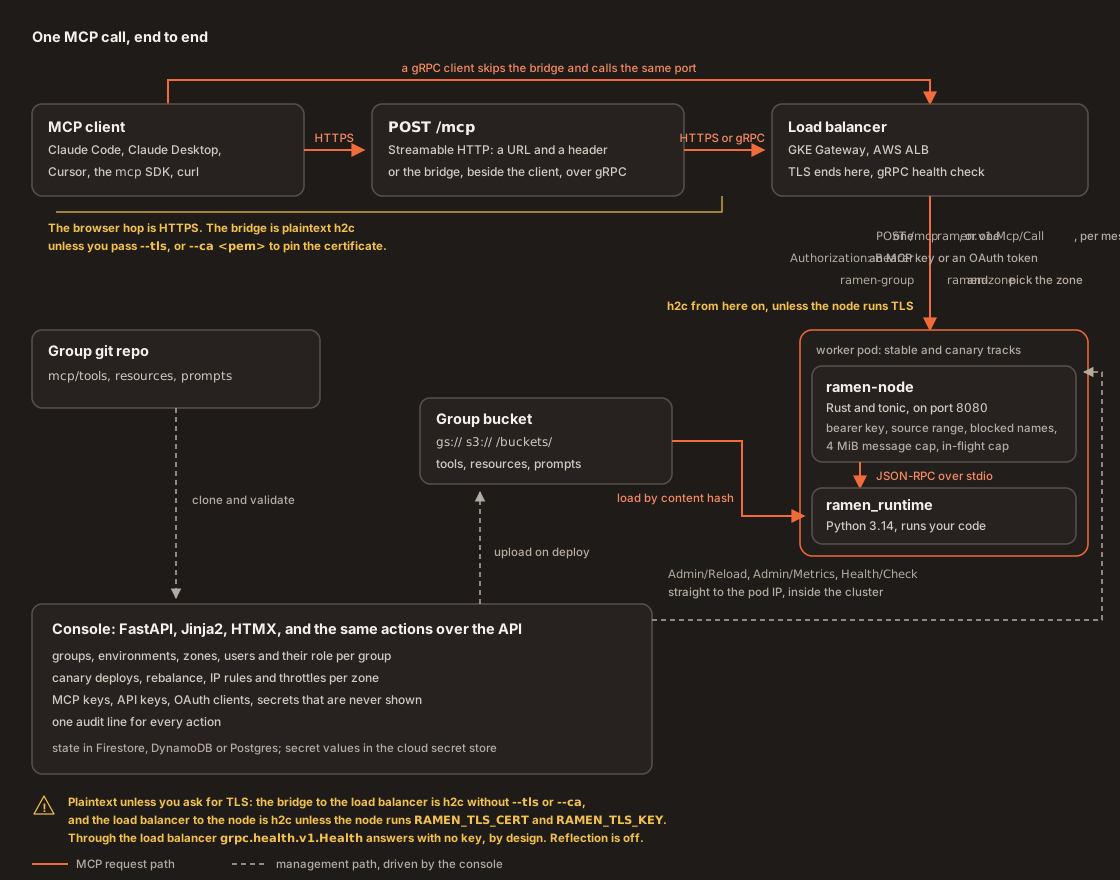
Since 0.5.0 a worker speaks two transports on one port, through one set of guards (contract §16):
- Streamable HTTP — the front door.
POST /mcpcarries one JSON-RPC 2.0 message (MCP spec 2025-06-18); the credential isAuthorization: Bearer, anrmk_key or a console-issued OAuth token. A URL and a header, so phones, browsers and hosted agent platforms are clients without installing anything. - gRPC —
ramen.v1.Mcp/Call, one message asbytes body(§11,mcp.proto). Kept for teams that want it internally, and what the stdio bridge speaks.
Nothing about MCP changed: the messages your client and your tools see are the standard ones. What matters for
security is that the HTTP handler does not have its own checks: it turns the request headers into the same metadata
map and calls the same guard and dispatch functions the gRPC service calls
(node-rs/src/http.rs →
grpc.rs::guard). The conformance suite runs the
whole guard table on both transports so a check that drifts fails there first.
Why the node is Rust
A worker runs two processes with one job each.
ramen-node(Rust, tonic) owns everything that must not be slowed down or broken by user code: the gRPC surface, key checking, source-range checking, the blocked-name filter, concurrency bounding, deadlines, health and the access log. It is a small, statically linked binary with no interpreter and no user code in its address space.ramen_runtime(Python 3.14) owns everything users write:pip install, proto validation, argument validation, secret substitution and the call itself.
They talk over newline-delimited JSON-RPC on stdin/stdout (contract §2) — no socket, no port,
nothing extra to secure. The runtime is spawned when needed and killed after RAMEN_SIDECAR_IDLE_SECS of idleness,
so a crash, a hang or a leak in tool code costs one respawn rather than the pod that is holding the keys.
Hop by hop
| Hop | What it is | What protects it |
|---|---|---|
| Client → edge (HTTP) | POST https://<edge>/mcp |
TLS at the load balancer; the credential in Authorization: Bearer; a browser Origin must be on the zone's allowlist (see Origin); a session id is signed and bound to the credential (see Sessions). The local compose worker is plain http:// on the laptop only |
| Client → bridge → edge (stdio) | a child process on the client's own machine, speaking gRPC over HTTP/2 to the edge | process boundary on the client; plaintext h2c unless you ask for TLS — --tls, or --ca <pem> to pin the server certificate. The key comes from RAMEN_MCP_KEY |
| Edge → node | GKE Gateway, or an AWS ALB → the zone's pods | TLS terminates at the load balancer; the LB → node hop is h2c unless the node runs its own TLS (RAMEN_TLS_CERT + RAMEN_TLS_KEY). Cloud Armor IP rules apply here on GCP — one policy per group, not per zone; on AWS a WAFv2 IP set and a web-ACL rule per group, applied on a real account since 0.5.6 |
| Edge → node, without a key | grpc.health.v1.Health, and gRPC reflection where it is enabled |
neither is key-checked or source-range-checked, so health answers anyone who reaches the edge — by design. Reflection would let them enumerate the services too, so it is switched off on deployed workers (RAMEN_REFLECTION=0 in the chart and both renderers) and answers UNIMPLEMENTED there; it stays on locally |
| Anything else → the pod, directly | other pods, or the cluster network | the worker NetworkPolicy (on by default): ingress to the node port only from the console's namespace and the load-balancer / health-check ranges. This — with the hardened container context — is what actually bounds direct access, and what makes the unauthenticated surface above tolerable |
Node (every Mcp/Call) |
the guard in front of your code | bearer key compared byte-for-byte in constant time with no early exit between keys (the length check in front of that compare is not constant time, so a key's length can leak); source range checked against RAMEN_ALLOWED_CIDRS; blocked names filtered; 4 MiB message cap; RAMEN_MAX_INFLIGHT cap |
| Node → runtime | JSON-RPC on stdio inside the pod | no network surface; the runtime is a child process of the node |
| Runtime → bucket | read of the group's prefix, by content hash | the zone's own cloud identity, scoped to that group's bucket prefix and that group's secrets. The AWS equivalent is an IAM role with IRSA, applied on a real account since 0.5.6 |
| Console → node | Admin/Reload, Admin/Metrics, Health/Check on the pod IP |
cluster-internal, and plaintext h2c unless the console itself has RAMEN_WORKER_TLS=1; Admin/* additionally needs x-ramen-admin-key and RAMEN_ADMIN_CIDRS, and is not routed through the load balancer at all |
The bearer key
Mcp/Call requires metadata authorization: Bearer <key>. The node compares the presented key against every
configured key in RAMEN_MCP_KEYS with a constant-time byte comparison, and folds over the whole key set without
an early exit on the first mismatch
(node-rs/src/auth.rs). One caveat, so it is
not read as more than it is: the byte compare is guarded by a plain length test, and that test is not constant
time — the length of a configured key can still be inferred from timing, though its bytes cannot. A miss is gRPC
UNAUTHENTICATED, and an empty key set denies everyone rather than letting everyone in. Error details never
echo key material.
Keys are generated per group in the console and written into the zone's config on deploy. Rotation is one action — the deploy rewrites the zone's Secret and rolls both Deployments for you — but it is not instant revocation: the old pods keep accepting the old key set until they finish draining, and the deploy job waits up to 180 s for that. Assume a revoked key still works for a few minutes.
One thing the access log does give away: every call is logged with a key_id, which is a short unsalted hash of
the key that was presented. It is not key material, and the log never contains the key itself — but anyone who
can read worker logs can hash a candidate key and see whether it appears. Worker logs are sensitive.
The source-range allowlist
RAMEN_ALLOWED_CIDRS is checked against the caller's address; outside it the call is PERMISSION_DENIED, and
IPv4-mapped IPv6 addresses are normalised before the match.
Which address counts as the caller's is the whole question, because behind a load balancer the peer is the
load balancer. RAMEN_TRUST_PROXY_HOPS = n answers it: take the n-th x-forwarded-for entry counted from the
right. Proxies append to that header, so its right-hand end is the part they wrote and everything left of it
is whatever the caller chose to send. Skipping the n - 1 right-hand entries your own proxies added lands
exactly on the address the outermost trusted proxy observed — an address a caller cannot pick. Set the count
correctly and the node's allowlist is a genuine check on the client address.
Everything else falls back to the peer address: trust off (n = 0), no header at all, fewer than n
entries, or an entry at that position that will not parse. That direction matters. Behind a load balancer the
peer is the proxy, so a client-range allowlist stops matching and starts denying — a wrong hop count costs you
availability, not confidentiality. It fails closed.
| Where | RAMEN_TRUST_PROXY_HOPS |
why |
|---|---|---|
| GCP, behind the external load balancer | 2 |
the load balancer appends the client, then itself |
| AWS, behind the ALB | 1 |
the ALB appends the client |
| local, compose, or straight to a pod | 0 (the default) |
there is no proxy — the peer is the client |
The worker chart and both console renderers set it per provider; you can override it, including to 0. The
legacy RAMEN_TRUST_PROXY=1 still works and means one hop, and an explicit RAMEN_TRUST_PROXY_HOPS wins over
it in both directions, so HOPS=0 is an explicit off switch.
What this list is not is the thing that stops something reaching a worker directly — that is the
NetworkPolicy. The allowlist decides which clients a reachable worker
will answer.
Unset, RAMEN_ALLOWED_CIDRS defaults to 0.0.0.0/0 and ::/0 — every source is allowed, and the bearer
key is the only gate. Setting per-zone IP rules in the console is what populates it on deploy.
RAMEN_ADMIN_CIDRS defaults to any in the same way and the console never writes it, so Admin/* stays reachable and x-ramen-admin-key is the gate
that always applies there. That does not make an IP lock free of consequences: a deploy also smoke-tests
tools/list as an ordinary Mcp/Call from the console, and that call is subject to RAMEN_ALLOWED_CIDRS. A
lock must therefore include the console's own source range as the worker sees it, or every later deploy fails at
the smoke step with PERMISSION_DENIED — which is why the cloud IP-rules test skips itself unless it is given
that range to add to the lock.
TLS
TLS terminates at the load balancer, which is the hop that crosses the internet. Everything behind it is
cleartext HTTP/2 by default — that is what GKE's appProtocol: kubernetes.io/h2c means, and it is the path that
was verified on a live GKE Gateway in 0.3.2. If you want the last hop encrypted too, give the node
RAMEN_TLS_CERT and RAMEN_TLS_KEY and switch the Service to HTTP2; that mode has local tests but has not
been exercised in a cloud deployment. Since 0.5.1 the node terminates TLS itself and offers both h2 and
http/1.1 on ALPN — tonic's own acceptor offers only h2, which refused every Streamable HTTP client at the
handshake (CI caught it after 0.5.0; the laptop had skipped the case for want of openssl).
Turning on node TLS is two changes, not one. The console dials worker pods with an insecure channel unless it
is also given RAMEN_WORKER_TLS=1 (plus RAMEN_WORKER_CA, or RAMEN_WORKER_CERT / RAMEN_WORKER_KEY for a
client certificate). Give the node TLS without the console side and the console keeps speaking cleartext to a TLS
port, so every Admin/Reload — and therefore every deploy — fails.
Clients choose their own side: ramen-mcp-bridge is plaintext unless you pass --tls or --ca. Two details
that catch people out:
--insecureoverrides--tlsand--cainstead of conflicting with them. A leftover--insecurein anmcpServersentry downgrades the connection silently, with no warning and no error.--ca <pem>replaces the trust store, it does not pin a certificate in the strict sense — the connection still verifies the hostname, it just anchors trust in that PEM. And because the Gateway certificate is self-signed until you supply a domain certificate,--tlson its own fails withCERTIFICATE_VERIFY_FAILED; in practice--cais required, not optional. That exact mistake cost a run in the 0.3.2 cloud verification.
Blocked names
Names in RAMEN_BLOCKED are filtered out of tools/list, resources/list and prompts/list and answered with
JSON-RPC -32601 when called — by name, and for resources by URI as well as by resolved name. Blocking is set in
the console per environment and per zone, so a model connected to one zone cannot see or call what that zone has
switched off.
Sessions
initialize over HTTP returns an Mcp-Session-Id of the form <nonce>.<expiry>.<mac>, where the MAC is
HMAC-SHA256 over the nonce, the expiry and the id of the credential that made the call, keyed with the zone's
RAMEN_SESSION_SECRET. Nothing is stored: any pod in the zone verifies an id, so there is no affinity to configure
and a rollout keeps sessions alive. Presented under another credential, past expiry (30 min by default) or altered,
the id is 404 — the spec's signal to re-initialize — never 401, so a stolen id reveals nothing and cannot be
replayed with a different key. The console writes the secret into every zone's deploy Secret; a group cannot set it
from its own deploy file. Without it the node generates one per process and says so in its log, and sessions then
die with the pod.
Origin
A request that carries a browser Origin header is refused with 403 unless the origin is on
RAMEN_ALLOWED_ORIGINS — and that list is empty by default, so a page on another site cannot use a victim's
browser to reach a worker through DNS rebinding. Non-browser clients send no Origin and are unaffected. A group may
open its own web origins from its deploy file; * is for a laptop.
OAuth tokens
When RAMEN_OAUTH_ISSUER names the console, a worker also accepts an HS256 access token the console minted for one
signed-in user: signature (key derived from the same zone secret), exp, issuer, audience and scope
(mcp:<group>:<zone>) must all check out, and the access log then names the user rather than a key id. Tokens live
one hour and are not individually revocable; refresh tokens are, through the user's session epoch. The worker
publishes /.well-known/oauth-protected-resource and answers a missing credential with
WWW-Authenticate: Bearer resource_metadata=…, which is how an OAuth-capable client finds the console. Two
practical notes: the metadata URL is absolute only when the deploy set RAMEN_PUBLIC_URL on the worker (the console
does so for a cloud zone; a pod cannot know its public address on its own), and behind a load balancer that routes
on ramen-group/ramen-zone a client must send those headers on the metadata request too, or the balancer has no
zone to send it to. Details and what the console checks before minting: the threat model.
The unauthenticated surface
Three things run ahead of every guard — no key, no source-range check: grpc.health.v1.Health, deliberately, so
that load balancers and Kubernetes can probe it; GET /.well-known/oauth-protected-resource, which is public
metadata by design (RFC 9728) and names only the console's URL and the resource identifier; and gRPC server
reflection (v1 and v1alpha), so that grpcurl works without a local copy of the proto.
Reflection is convenient on a laptop and a disclosure at an edge: anyone who could reach it could list the
services and print their definitions, ramen.v1.Admin included, from a source range the MCP allowlist denies.
So it is gated by RAMEN_REFLECTION, which is on by default and switched off on deployed workers — the
worker chart and both console renderers set RAMEN_REFLECTION=0. With it off the reflection services are not
registered at all and answer UNIMPLEMENTED, so what the load balancer will list for an anonymous caller is
nothing. Locally and in compose, where the port is not exposed to anyone else, reflection stays on.
Health remains unauthenticated everywhere by design. It reports readiness and nothing more.
What bounds direct access to a pod
The worker NetworkPolicy (enabled by default) admits ingress to the node port only from the console's namespace
and from the load balancer's front-end and health-check ranges — the VPC CIDR on AWS. Together with the hardened
container context (non-root, allowPrivilegeEscalation: false, all capabilities dropped, RuntimeDefault
seccomp) it is the control that answers "what stops another pod, or the internet, from reaching the node
directly", and it is what makes the unauthenticated health and reflection surface tolerable. It is also what
closed the direct-access item of the 0.3.0 security audit.
The deploy file is a configuration channel
The node's configuration comes from three places, in order: a RAMEN_CONFIG yaml, then the process environment,
then the deploy file the console writes into the group's bucket (.ramen/env-<zone>), re-read on every
Admin/Reload. That last source is a channel, not just data, and it is worth knowing both halves of what it can
do. It can set RAMEN_MCP_KEYS and RAMEN_ALLOWED_CIDRS — so write access to a group's bucket prefix is the
ability to add an MCP key and to widen that zone's address allowlist — along with the block list, the in-flight
and timeout limits, the idle timer and the log file. It deliberately cannot set the bucket, the port, the
Python interpreter, the group or zone identity, the admin key, or the proxy-trust setting. That exclusion list is
a real control: the same write access cannot repoint a worker at another group's code, take over its admin
surface, or change how it decides a caller's address.
Per-zone cloud identity
Attaching a zone creates its own cloud identity, bound to the zone's Kubernetes service account: on GCP a service
account with objectViewer limited to that group's bucket prefix and secretAccessor limited to that group's
secrets, through Workload Identity. Two zones of two groups on the same cluster therefore cannot read each other's
code or secrets even if the network is misconfigured. The AWS equivalent is an IAM role with IRSA, applied on a real
account since 0.5.6.
The separation is about contents, and one edge is worth naming: the IAM condition that scopes the storage role matches the group's object prefix or the bucket resource itself, because that is what a bucket listing is checked against. A group's worker identity can therefore enumerate object names across the shared groups bucket, including other groups' paths. It cannot read those objects — only see that they exist.
Transport errors versus protocol errors
gRPC status codes describe the edge, JSON-RPC errors describe your code. A bad key is UNAUTHENTICATED, a blocked
source range is PERMISSION_DENIED, an oversized message is OUT_OF_RANGE, too many in-flight calls is
RESOURCE_EXHAUSTED; a blocked or unknown tool is JSON-RPC -32601 and an exception in your tool is
isError: true. A client can always tell "the edge rejected me" from "the tool said no". One caveat on that
in-flight cap: the semaphore is sized when the pod starts and an Admin/Reload does not resize it, so although
a deploy is allowed to set RAMEN_MAX_INFLIGHT, the new value only takes effect the next time the pod
restarts. grpc.health.v1.Health
is unauthenticated by design, so load balancers and Kubernetes can probe it, and it reports SERVING only after
the runtime has actually loaded the group's code.
What is verified, and what is not
This section is the single record. The home page, How it works and the threat model each carry one sentence and point here.
-
Verified live in 0.6.0 on both clouds, each with two zones of one group behind one load balancer: a canary deploy to both zones,
POST /mcpthrough the edge on each, the per-token Redis throttle counting across zones,mcp/env.yamlrendered from a secret into the runtime's environment, the bridge with a group key and the bridge signing a person in with--oauth, and dropping a zone taking its namespace and its cloud identity with it. GCP ran on Firestore and then again on in-cluster Postgres; AWS ran on DynamoDB with Secrets Manager, and neededRAMEN_PUBLIC_URLset before its workers would accept console-minted tokens. Both were torn down the same day. -
Verified live in 0.5.1 on one GKE Autopilot cluster through the Gateway load balancer:
POST /mcpwith anrmk_key routed byramen-group/ramen-zoneto the zone's pods, the 401/403 answers and the session id through the balancer, the OAuth flow from the console's consent page to atools/callwith the token, refresh rotation and reuse revocation, and the worker's RFC 9728 challenge naming the console (scripts/oauth_roundtrip.py,scripts/cloud_smoke.sh). The harness ran 218 passed, 0 failed, 15 skipped with stated reasons. Two things the run taught: the Gateway takes minutes to program a new route (until then/mcpis a404from the console), and a console rollout answers503through the balancer for about a minute. - Verified in 0.5.0 on real node processes: the whole guard table on both transports (key,
source range, blocked names, 4 MiB and in-flight caps, protocol errors as JSON-RPC bodies, notifications), the
HTTP-only checks (Origin, sessions bound to the credential and refused under another key, content negotiation,
protocol version, the RFC 9728 metadata), a console-minted OAuth token accepted by the node, and the official
mcpSDK's Streamable HTTP client end to end. All of it runs in CI on Linux and on a Windows runner that builds the node natively (tests/conformance/test_transports_local.py). Since 0.5.1 it also covers Streamable HTTP over node TLS, which CI found broken after 0.5.0 (see TLS above). - Verified live, on one GKE Autopilot cluster in
us-central1(0.3.2), with the whole harness green through the load balancer (126 passed, 0 failed):- header routing on
ramen-group/ramen-zoneover h2c, and gRPC health checks; Mcp/Callwith and without a key (Unauthenticatedwithout);Admin/*not reachable through the load balancer; the bridge end to end through the officialmcpSDK stdio client against<edge>:443with--tls --ca;- driven from the console, against the real deployment: blocking a tool and unblocking it again; setting
an IP lock (the node answered
PERMISSION_DENIEDoutside the range while health stayed reachable, with the Cloud Armor policy in place) and restoring it; canary deploy and rollback; rebalance; the per-zone service account with its bucket-prefix and per-secret IAM bindings and its Workload Identity binding; secrets; and logs. - Scope, stated plainly: one cluster, one zone, one group, on one day, and the project was deleted the same day. Later releases repeated the pattern (0.5.1, 0.5.6, 0.5.8, 0.5.95, 0.6.0), each on a project or account torn down the same day; nothing stays running between releases.
- header routing on
- Verified by tests only: node TLS, the
RAMEN_MAX_INFLIGHTand size caps, andx-forwarded-forhop counting — including a test that a caller-supplied header cannot move the address the node checks, at each provider's hop count. Note what that does not say: the hop counts above (GCP 2, AWS 1) andRAMEN_REFLECTION=0landed after the 0.3.2 cloud run. Since then every cloud run has served real traffic through a load balancer at those hop counts without a source-range false denial, which exercises them incidentally; no run has yet tested a forgedx-forwarded-foragainst a real edge. - Verified on AWS since 0.5.6: the Terraform for EKS, DynamoDB, S3, Secrets Manager and the ALB with gRPC target groups has been applied to a real account in 0.5.6, 0.5.8 and 0.6.0, and the published bridge was server-tested against it in 0.5.8, which is how the certificate's name gap was found. Least exercised there: WAF rule convergence under change, and rebalance weights under load. Deploy on AWS says what each run covered.
- By design, not a defect: the runtime executes your group's code in a process that holds that group's secrets in its environment. Tool code in a group can read that group's secrets directly. Isolation between groups is the pod, the namespace and the per-zone identity — not the Python process. See the threat model.
Connecting
Standard MCP clients do not see any of this. The front door is a URL and a header:
{"mcpServers": {"ramen": {"url": "https://<edge>/mcp",
  "headers": {"Authorization": "Bearer ${RAMEN_MCP_KEY}", "ramen-group": "<g>", "ramen-zone": "<z>"}}}}
Keep the key in RAMEN_MCP_KEY rather than in the file. Leave Authorization out and an OAuth-capable client will
follow the worker's 401 to the console and sign the user in for a token scoped to that person.
Clients that only speak stdio use ramen-mcp-bridge, a stdio MCP server that forwards each message to Mcp/Call
over gRPC — the compatibility path, unchanged since 0.3.1:
RAMEN_MCP_KEY=<key> ramen-mcp-bridge --target <host:port> --group <g> --zone <z> [--tls|--insecure] [--ca <pem>]
Every flag has an environment variable behind it (RAMEN_BRIDGE_TARGET, RAMEN_BRIDGE_GROUP, RAMEN_BRIDGE_ZONE,
RAMEN_BRIDGE_TLS, RAMEN_BRIDGE_CA; the key from RAMEN_MCP_KEY or RAMEN_BRIDGE_KEY). Never pass --key on a
shared machine: a command line is visible to every other user through ps.
The local compose stack is the other place to be careful. It publishes the worker on host port 8080 as plaintext
h2c with an open address allowlist, a committed MCP key and a committed admin key, and no RAMEN_ADMIN_CIDRS —
so on a developer laptop Admin/Reload is reachable by anything that can reach the port, using a key that is in
this repository. That is fine for make up on a machine you control and is not a deployment posture.
Anything that speaks gRPC can skip the bridge and call ramen.v1.Mcp/Call directly. Locally, server reflection
is on, so grpcurl works without a local copy of the proto; against a deployed worker it is
switched off, so pass -import-path proto -proto ramen/v1/mcp.proto there. See the
Get started and the MCP repo.