




Ramen turns a git repo of tools, resources and prompts into a fleet of MCP workers behind a cloud load balancer.
Each worker is a Rust MCP node (JSON-RPC 2.0 over gRPC, auth, IP allow-lists, metrics) paired 1:1 with a
Python 3.14 runtime that runs your code. Standard MCP clients (Claude Desktop, Cursor, the mcp SDK) connect
through the ramen-mcp-bridge stdio bridge. A single FastAPI console manages groups, environments, zones,
secrets, canary deploys, rebalancing, logs and audit, and every action is also available through an API key.
Git → bucket → worker
Push mcp/tools/<name>/<name>.py + <name>.json to a repo. Deploy syncs it to a bucket; workers pip-install and load it. Protos →
gRPC transport (v0.3.1)
One ramen.v1.Mcp/Call per JSON-RPC message: binary framing, HTTP/2 multiplexing, first-class health and deadlines. The LB routes on ramen-group / ramen-zone metadata. Transport →
Canary by default
Every deploy rolls a canary first, smoke-tests tools/list, then rolls the stable track. Failure = canary scaled to 0, stable untouched. Canary →
Enterprise controls
Super admin / group admin / viewer, rmk_ MCP keys, rmn_ API keys, per-zone IP rules (Cloud Armor / WAF), secrets never shown, full audit log. Security →
Quickstart (local, 5 commands)
Needs Docker (compose v2), uv, git. About 3–5 minutes on the first run (image builds).
git clone https://github.com/bkraad47/ramen && cd ramen
make up          # Firestore emulator + console (https://localhost:8443) + one worker (gRPC localhost:8080, h2c)
make demo        # creates group `demo` from the demo repo, mints an rmk_ key, deploys, calls the tool via the bridge
# → demo_calculator_tool({"var1": 2, "var2": 3, "func": "add"}) -> 5
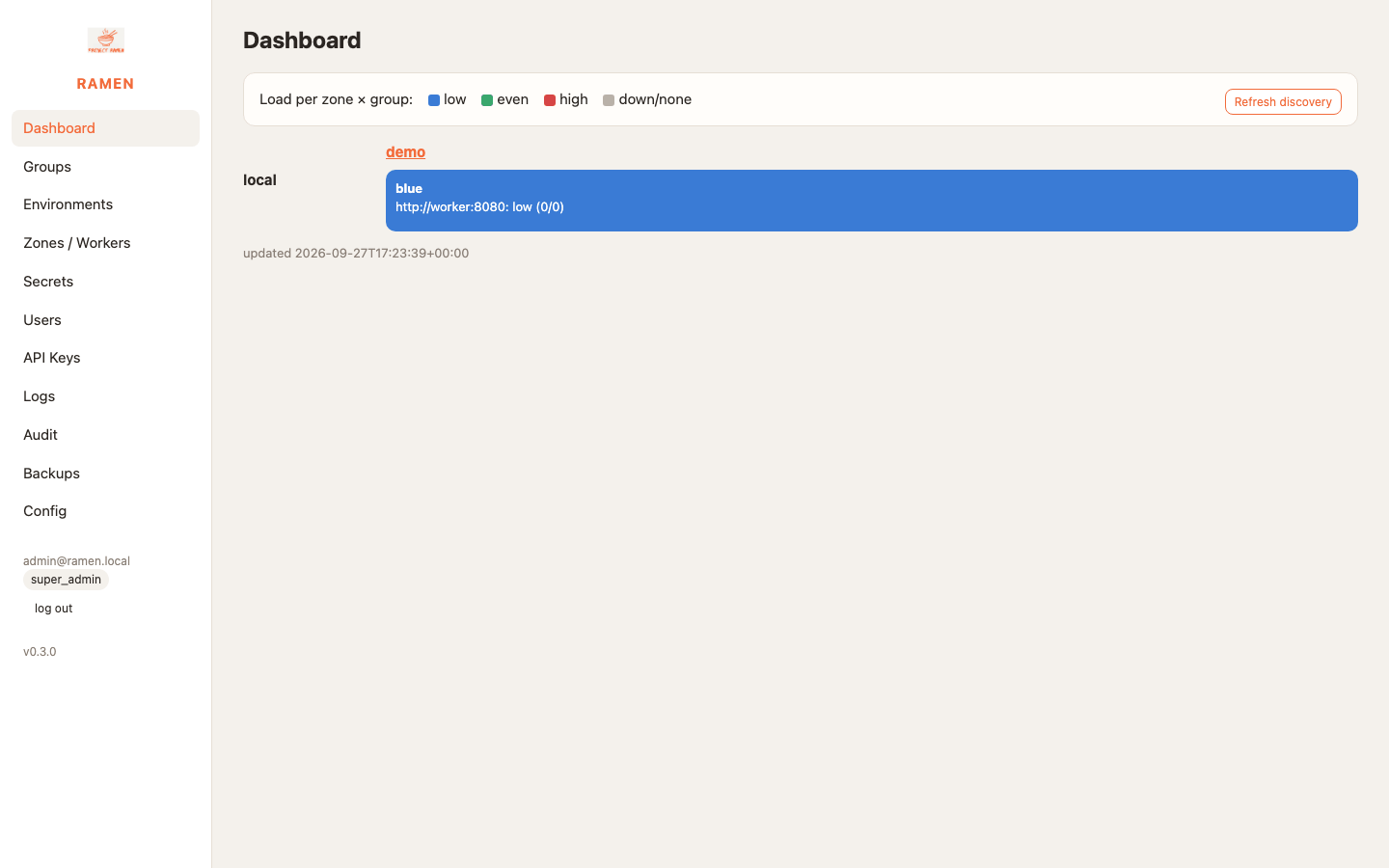
open https://localhost:8443   # self-signed cert; login admin@ramen.local / changeme-ramen
make down        # stop and remove volumes
The console is https://localhost:8443 (accept the self-signed certificate), login admin@ramen.local /
changeme-ramen (from deploy/local/.env). The worker is a gRPC endpoint on localhost:8080 that takes a
rmk_ MCP key minted on the group page. Point Claude Desktop, Cursor or the mcp SDK at it with the bridge:
Full walkthrough with a Claude Desktop config, an mcp SDK snippet and a raw grpcurl call:
Local quickstart. Coming from 0.3.0? The HTTP /mcp endpoint is gone:
migration note.
Deploy to the cloud
| Target | Status | Guide |
|---|---|---|
| GCP (GKE Autopilot, Firestore, GCS, Secret Manager, global HTTPS LB with gRPC header routing, Cloud Armor) | verified on a throwaway project in 0.3.0 (89/89 cloud tests); 0.3.1 gRPC routing re-verified locally, cloud re-run pending | GCP how-to |
| AWS (EKS, DynamoDB, S3, Secrets Manager, ALB gRPC target groups, WAF) | built and unit-tested only; never applied to a real account | AWS how-to |
| Local (docker compose) | CI e2e on every push | Local quickstart |
Where next
- How it works and why · Architecture · Interface contracts
- Secrets · DevOps with the API · Cloud-ops agent skills
- Versions · Releases · Demo group repo
- For LLM agents:
llms.txt