Secrets
Model
A secret is {name, value, env?, zone?} under a group. Scope rules: a secret with no env/zone applies to every
environment and zone of the group; with env only to that environment; with env + zone only to that zone of
that environment. On deploy, the console resolves the secrets that match the target env + zone and injects them
into the workers as RAMEN_SECRET_<GROUP>__<NAME> (upper-cased). More specific scopes win on a name clash.
Values are never returned: not by the API, not on the Secrets page, not in backups, not in logs. Admins add and delete; viewers see names only.
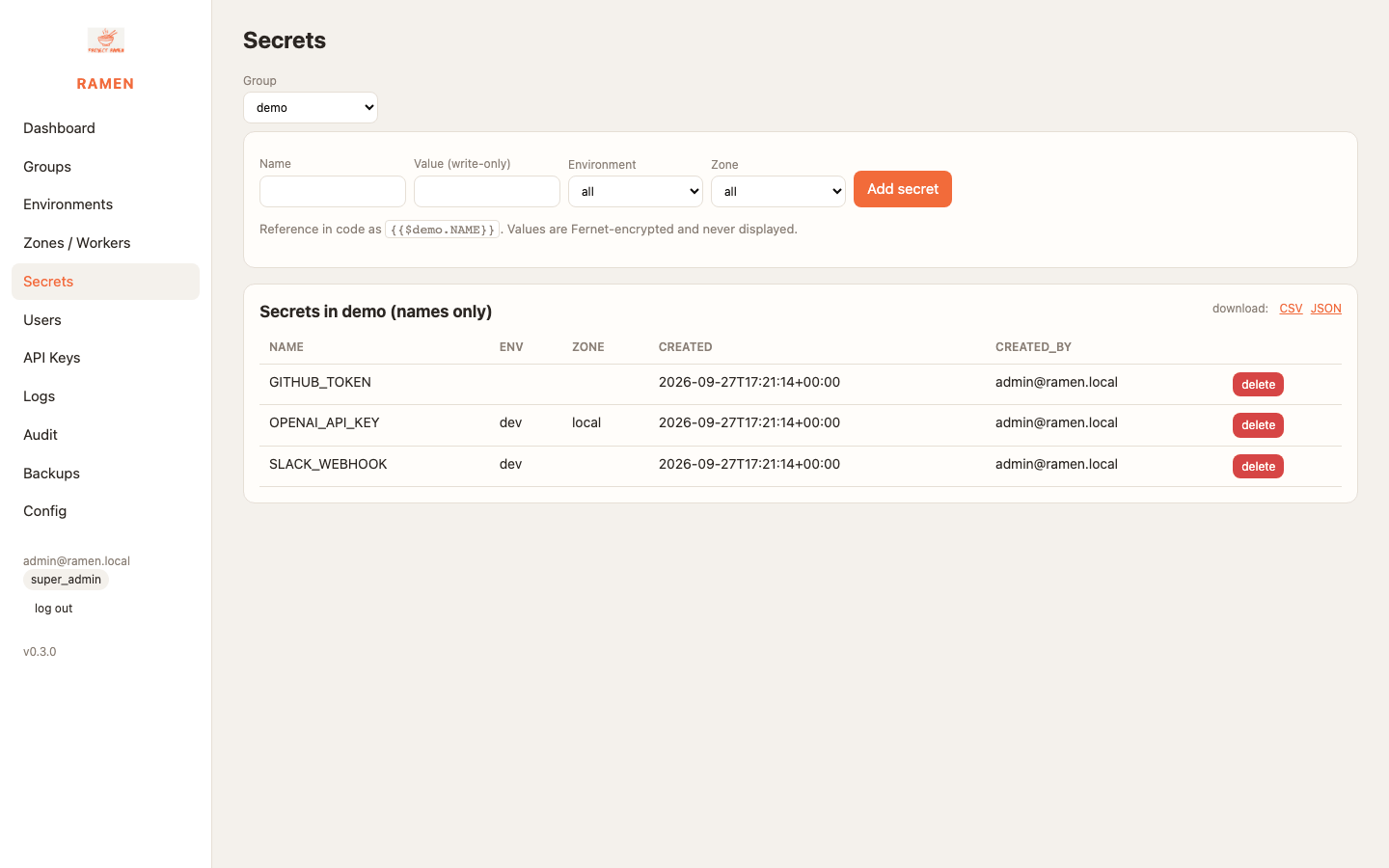
Add
Secrets → choose the group → name, value, optional env and zone → Add.
Then deploy the environment; secrets reach workers only through a deploy.
Use in tool code
def call_llm(prompt):
    key = "{{$demo.OPENAI_API_KEY}}"      # substituted by the runtime before the call
    ...
{{$<group>.<NAME>}} (nested too) is substituted before your function runs, and
code can call ramen_runtime.secrets.resolve(text) explicitly. Unknown references stay literal. Values are redacted
from exception messages and never logged.
Backends
RAMEN_SECRETS_BACKEND |
Where values live | Notes |
|---|---|---|
store (default, local) |
the console store, Fernet-encrypted with RAMEN_FERNET_KEY |
|
gcp |
Secret Manager ramen-<group>-<env|all>-<zone|all>-<NAME> (labels group/env/zone) |
store keeps name + sm:// ref; worker GSA has secretAccessor on ramen-<group>-* |
aws (untested) |
Secrets Manager ramen/<group>/<env|all>/<zone|all>/<NAME> (tags) |
store keeps asm:// ref |
rmk_ MCP keys are stored through the same backend (kind: mcp_key).
Special names
GITHUB_TOKEN: used by the console to clone a private group repo (env- or group-scoped). Alternative: the group's fallback GitHub token field (stored encrypted, never shown).
Rotation
Add the new value under the same name (delete + add), deploy. Workers pick it up on Admin/Reload during the
canary step. The rotate-keys skill covers keys and the Fernet key.